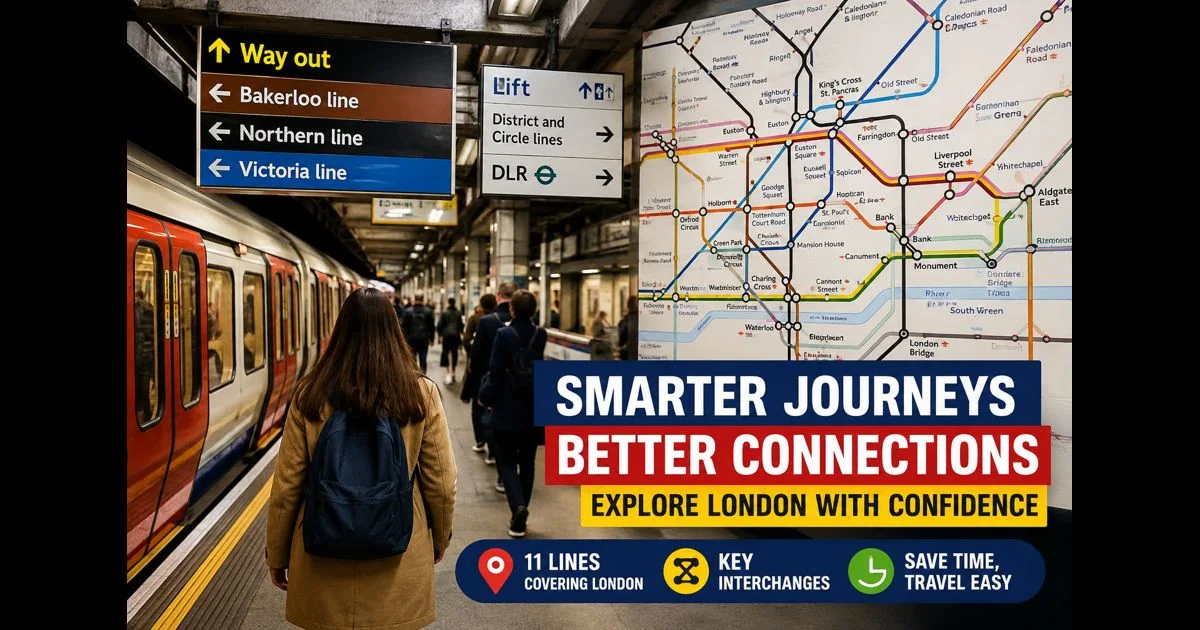
LondonTubeMap: Your Guide to London Underground Lines and Key Interchanges
A LondonTubeMap is more than a list of stations. It shows how London’s Underground lines connect, where passengers can change trains, and which stations act as gateways to major parts of the city.
The Underground is often the quickest way to travel across London, but the right route is not always the one with the fewest stops. A direct line may take longer than a route with one simple interchange, while a large station can make an apparently easy change more time-consuming than expected.
Understanding the lines and their key connections makes it easier to choose routes with confidence. For a full explanation of symbols, zones and the map’s layout, see this guide to the London Tube map.
The 11 London Underground Lines
London Underground has 11 lines, each identified by a name and a distinct colour on the map.
- Bakerloo
- Central
- Circle
- District
- Hammersmith & City
- Jubilee
- Metropolitan
- Northern
- Piccadilly
- Victoria
- Waterloo & City
Some lines travel through central London and extend far into outer areas. Others cover shorter, more specialised routes. The Waterloo & City line, for example, links Waterloo and Bank, while the Central and Northern lines cross large parts of the capital.
The colour coding makes it possible to trace a route quickly. It is still important to check the train destination at the platform, because several lines divide into branches.
Bakerloo Line
The Bakerloo line runs between Harrow & Wealdstone in the north-west and Elephant & Castle in south London. It passes through important central stations including Paddington, Baker Street, Oxford Circus, Piccadilly Circus, Charing Cross and Waterloo.
It is especially useful for journeys involving Paddington, Marylebone, Regent Street, the West End and Waterloo. At Baker Street, passengers can change to several other Underground lines. Oxford Circus provides a straightforward connection with the Central and Victoria lines.
Central Line
The Central line runs broadly from west to east through the centre of London. It serves major stations including Notting Hill Gate, Oxford Circus, Tottenham Court Road, Bank and Liverpool Street.
It is a useful line for travelling to central shopping areas, the City of London, east London and connections near Stratford. The line has branches at both ends, so passengers should check the destination before boarding.
At Oxford Circus, the Central line connects with the Bakerloo and Victoria lines. At Tottenham Court Road, it connects with the Northern line and the Elizabeth line. Bank offers links with the Northern line, Waterloo & City line and the Docklands Light Railway.
Circle Line
The Circle line travels around central London in a loop-like route, though the service itself is not a complete circular service. It shares tracks with other lines in several places and serves stations including Paddington, Baker Street, King’s Cross St Pancras, Liverpool Street, Tower Hill and Victoria.
It can be useful for reaching railway terminals, museums and areas around the edge of central London. Because it shares sections with the District, Hammersmith & City and Metropolitan lines, platform signs and train destinations should always be checked.
District Line
The District line serves a large part of west and east London. Its branches reach destinations including Richmond, Wimbledon, Ealing Broadway, Upminster and Edgware Road.
It is useful for travel to South Kensington, Victoria, Westminster, Tower Hill, Kew, Richmond and Wimbledon. Its multiple branches make it one of the lines where checking the destination display is essential.
Earl’s Court is a major District line interchange. It helps passengers move between the western branches and continue toward central or east London. The station can be busy, so allow extra time when changing there.
Hammersmith & City Line
The Hammersmith & City line runs from Hammersmith to Barking. It passes through Paddington, Baker Street, King’s Cross St Pancras, Liverpool Street and Whitechapel.
It provides a useful east-west link north of central London and shares track with the Circle and Metropolitan lines in places. It can be a practical alternative when other central routes are crowded or disrupted.
Its connection at Paddington is valuable for travellers arriving by mainline train or heading toward Heathrow via rail services. King’s Cross St Pancras provides access to multiple Tube lines and national rail connections.
Jubilee Line
The Jubilee line runs from Stanmore in north-west London to Stratford in east London. Its central section serves Baker Street, Bond Street, Green Park, Westminster, Waterloo, London Bridge and Canary Wharf.
It is one of the most useful lines for visitors and commuters because it connects key central locations with major business districts and east London.
The Jubilee line has important interchanges at Baker Street, Green Park, Westminster, Waterloo, London Bridge and Stratford. Canary Wharf is a major destination in its own right and also provides connections with the Elizabeth line and Docklands Light Railway.
Metropolitan Line
The Metropolitan line reaches north-west London and serves branches toward Amersham, Chesham, Uxbridge and Watford. In central London, it stops at key stations including Baker Street, King’s Cross St Pancras, Liverpool Street and Aldgate.
It is particularly useful for journeys between central London and north-western suburbs. Because of its outer branches, passengers should always confirm the destination before boarding.
Baker Street is a key station for the Metropolitan line, connecting with the Bakerloo, Circle, Hammersmith & City and Jubilee lines. This makes it a useful interchange, but it can also be busy.
Northern Line
The Northern line is one of the most extensive and complex Underground routes. It serves northern, central and southern London, with branches through central areas and different destinations to the south.
Important stations include Camden Town, King’s Cross St Pancras, Euston, Tottenham Court Road, Leicester Square, Waterloo, London Bridge and Bank.
The two central branches are particularly important. One route passes through Charing Cross, while another passes through Bank. Before travelling, check which central branch serves your destination.
Camden Town is an important Northern line interchange, while Euston connects with the Victoria line. King’s Cross St Pancras, Tottenham Court Road, Waterloo, London Bridge and Bank also provide valuable connections to other lines and rail services.
Piccadilly Line
The Piccadilly line runs from Cockfosters in north London to Heathrow Airport and Uxbridge in the west. It passes through King’s Cross St Pancras, Holborn, Covent Garden, Leicester Square, Piccadilly Circus, Green Park and South Kensington.
It is one of the most useful lines for visitors because it serves central London attractions and provides a direct Underground route to Heathrow terminals. However, not every Piccadilly line train goes to the same Heathrow terminal, so checking the destination is important.
Green Park is a major interchange for the Piccadilly, Jubilee and Victoria lines. Leicester Square connects with the Northern line and is useful for the West End. South Kensington provides access to museums and links with the District and Circle lines.
Victoria Line
The Victoria line runs between Walthamstow Central and Brixton. It serves stations including King’s Cross St Pancras, Euston, Oxford Circus, Green Park, Victoria and Vauxhall.
It is often a fast option for travelling north to south through central London. Its route is relatively straightforward, with no branches to navigate.
Oxford Circus is one of its most important interchanges because it connects the Victoria line with the Bakerloo and Central lines. Green Park adds a connection to the Jubilee and Piccadilly lines, while Victoria offers extensive mainline rail, coach and Underground connections.
Waterloo & City Line
The Waterloo & City line is a short route between Waterloo and Bank. It is primarily useful for travel between Waterloo station and the City of London.
Although it has only two stations, it offers a valuable connection for passengers arriving at Waterloo who need to reach Bank, Monument or nearby financial-district locations.
At Bank, passengers can connect to the Central and Northern lines, the Docklands Light Railway and several nearby rail links.
Key Interchanges to Know
A key interchange is a station where several routes meet. These stations provide flexibility, but they can also involve longer walks between platforms.
Baker Street
Baker Street connects the Bakerloo, Circle, Hammersmith & City, Jubilee and Metropolitan lines. It is useful for travel between north-west London, central London and the West End.
Green Park
Green Park connects the Jubilee, Piccadilly and Victoria lines. It is one of the easiest ways to move between north-south and east-west routes in central London.
King’s Cross St Pancras
King’s Cross St Pancras connects the Circle, Hammersmith & City, Metropolitan, Northern, Piccadilly and Victoria lines. It also provides access to major national and international rail services.
Because of its size, allow extra time to change trains, especially if carrying luggage.
Oxford Circus
Oxford Circus connects the Bakerloo, Central and Victoria lines. It is a useful station for Regent Street, Oxford Street and central shopping areas, but can become very busy during peak shopping periods.
Paddington
Paddington connects the Bakerloo, Circle, District and Hammersmith & City lines, alongside mainline rail and Elizabeth line services. It is a major station for west London and airport journeys.
Victoria
Victoria connects the Circle, District and Victoria lines with one of London’s busiest railway terminals. It is an important station for rail, coach and Underground connections.
Waterloo
Waterloo connects the Bakerloo, Jubilee, Northern and Waterloo & City lines. It also links directly with Waterloo mainline station, making it a key point for travel into and out of London.
London Bridge
London Bridge connects the Jubilee and Northern lines with mainline rail services. It is useful for Borough Market, the Shard, the City and connections toward south-east London.
Liverpool Street
Liverpool Street connects the Central, Circle, Hammersmith & City and Metropolitan lines, as well as mainline and Elizabeth line services. It is a major gateway to the City of London and east London.
Bank and Monument
Bank and Monument are linked stations with a large network of passages. Together they connect the Central, Northern, Waterloo & City, Circle and District lines, along with the Docklands Light Railway.
The connection can involve a significant walk, so it may not be the best choice for every journey.
Choosing the Best Interchange
The best interchange depends on the journey, not simply the number of lines at a station. A major station gives more route choices, but a smaller connection may be easier and quicker.
When choosing where to change, consider:
- How far you need to walk between platforms
- Whether the station is busy at that time
- Whether the route is step-free
- Whether the next train serves the correct branch
- Whether a nearby alternative offers a simpler journey
For route-planning advice beyond the map itself, use this practical Underground journey guide.
Travel With the Network in Mind
A LondonTubeMap becomes much easier to use when you recognise the role of each line and the stations where routes meet. The map helps you compare options, avoid unnecessary changes and choose a journey that fits your destination.
Check the train destination before boarding, allow extra time at large interchanges and review live service updates before leaving. With those simple habits, London’s Underground network becomes far easier to navigate.
