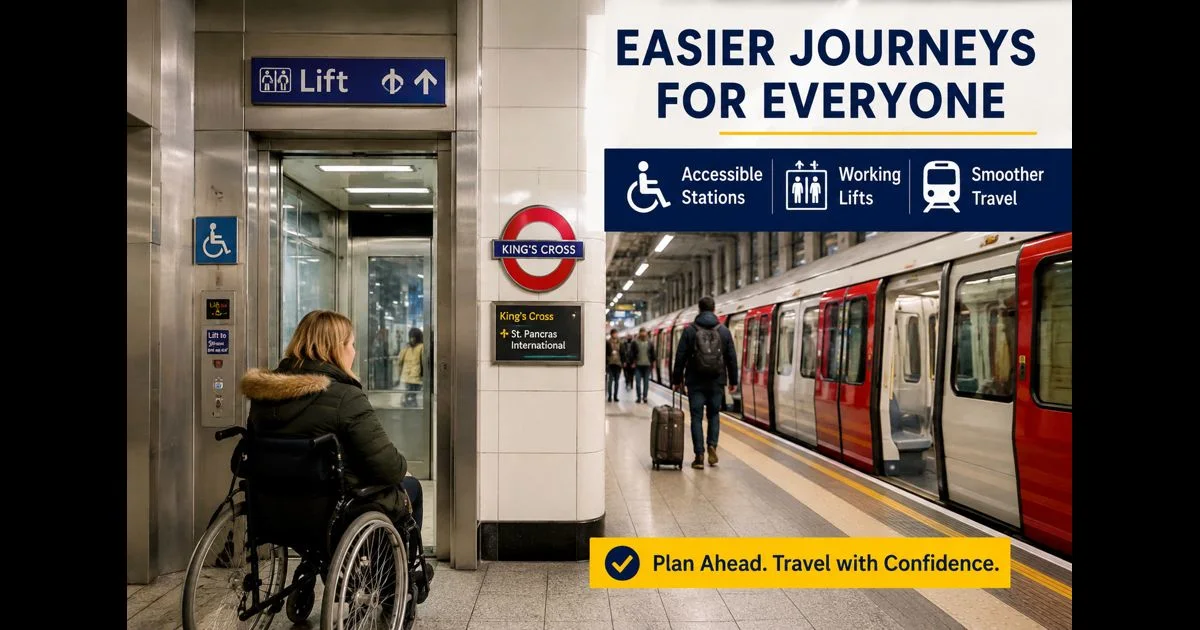
Step-Free London Tube Map: Accessible Stations, Lifts and Easier Routes
A step-free London Tube map helps passengers plan journeys that avoid stairs and escalators. It is especially useful for wheelchair users, people with reduced mobility, parents with pushchairs, travellers carrying luggage, and anyone who finds stairs difficult.
Step-free travel on the London transport network is possible in many places, but it is important to understand what “step-free” means at each station. Access can be available from street to platform, from street to train, or only between certain lines at an interchange. Lifts, ramps, platform gaps and temporary closures can all affect the route.
The most reliable approach is to plan before travelling and check live updates on the day of the journey.
What Step-Free Access Means
Step-free access means that a passenger can move through part or all of a station without using stairs or escalators. This may involve lifts, ramps, level surfaces and accessible entrances.
There are two important types of step-free access on the Tube map:
- Street to platform: You can travel between street level and the platform without stairs or escalators, but there may still be a noticeable step or gap between the platform and the train.
- Street to train: You can travel from street level to the train with a small step or gap, allowing many passengers to board without a large change in level.
These are not the same thing. A station with step-free access to the platform may still require a boarding ramp to bridge the gap between the train and platform.
The standard map uses accessibility symbols, but the dedicated step-free guide gives more detail about station access, interchanges and platform-to-train boarding.
Why a Step-Free Route Needs More Planning
A conventional Tube journey may only involve checking the correct line and direction. A step-free journey needs a little more attention because the easiest route can change when lifts, ramps or accessible interchanges are considered.
A route with one train change may not be suitable if the interchange includes stairs. Another route with more stops may be better if it has step-free access throughout.
Before travelling, check:
- Whether the starting station is step-free
- Whether the destination station is step-free
- Whether every planned interchange is step-free
- Whether access is available in both directions
- Whether a lift is working
- Whether a boarding ramp may be required
- Whether the station has a suitable accessible entrance
This is why route planning matters as much as the line itself. For general line, station and map-symbol guidance, see the London Tube map guide.
Read Step-Free Symbols Correctly
Accessibility symbols on a Tube map offer useful guidance, but they should not be treated as a complete guarantee for every journey.
A symbol may show that a station is step-free from street to platform or from street to train. It may also indicate a step-free interchange between specific lines. However, access arrangements can be different depending on the entrance used, platform direction or train service.
For example, a station might allow a step-free transfer between two lines but not provide step-free access to every platform. Another station may have lifts, but one may be temporarily unavailable because of maintenance or a fault.
Always look at the latest step-free information rather than relying on an old screenshot or a downloaded map from a previous trip.
Lifts Are Essential to Many Journeys
Many accessible Tube journeys depend on lifts. A station may have a lift from street level to the ticket hall, another to the platform, or several lifts across a large interchange.
Lifts can make a route possible, but they also create a point that needs checking before travel. If a lift is out of service, the planned route may no longer be step-free.
Transport for London publishes information about planned station works and lift closures. On the day of travel, check current station status before leaving home or accommodation.
If you arrive and find that a lift is unavailable, speak to a member of station staff. They can help assess alternative step-free routes and explain what assistance is available.
Platform Gaps and Boarding Ramps
Step-free access to the platform does not always mean level boarding onto the train. At many stations, there can still be a gap or a step between the platform edge and the train door.
Where the gap is too large for safe independent boarding, staff may use a boarding ramp. Some stations also have mini ramps to bridge smaller gaps.
Passengers who may need a ramp should make themselves known to station staff. Staff can help arrange assistance at the departure station, destination and relevant interchange stations.
When waiting for a train, look for accessible boarding-point signs on the platform. These signs may appear on the wall, floor or overhead. They show where to wait so the relevant train doors stop in the best position for accessible boarding.
The accessible boarding point can vary by line and direction, so follow the station signage rather than assuming the same carriage position works everywhere.
Choose Easier Interchanges
An interchange is a station where passengers change from one line to another. For a step-free journey, the interchange is often the most important part of the route.
Some large stations have step-free routes between certain lines, but not all lines. Other stations provide step-free access from street to platform but require stairs for a particular transfer.
A good accessible interchange should be checked for:
- Lift availability
- Step-free access between the specific lines used
- Direction of travel
- Platform-to-train access
- Walking distance within the station
- Current crowding or planned works
Do not choose an interchange only because it looks central or has many lines. An alternative station may offer a smoother, more reliable connection.
For help comparing a complete route before travelling, use this practical Underground journey-planning guide.
Use the Elizabeth Line and DLR Where Helpful
The Underground is only one part of London’s wider transport network. The Docklands Light Railway and Elizabeth line can offer useful alternatives for accessible travel.
All DLR stations provide step-free access. The Elizabeth line also has extensive step-free provision, which can make it a valuable choice for journeys across London or between central stations and Heathrow.
Depending on the journey, using the Elizabeth line, DLR, London Overground, buses or a combination of services may be easier than relying on the Tube alone.
The best accessible route is not always the fastest route shown on a standard map. It is the route that works safely from start to finish on the day you travel.
Staff Assistance Can Make a Journey Easier
Passengers can ask station staff for assistance without booking in advance. This is often called a “turn up and go” service.
Staff can help with directions, accessible routes, lifts, boarding ramps and making sure assistance is arranged at a destination or interchange. If you would like help boarding or leaving a train, speak to a member of staff as soon as you arrive at the station.
It is useful to allow extra time for a journey when assistance may be needed. This is particularly important at busy stations, during peak travel periods or when making a connection to a train, airport service or appointment.
If you feel unsure about a route, ask before going through the ticket gates. Staff can often identify a simpler step-free alternative.
Plan Around Lift Closures and Disruptions
Accessibility information can change quickly. A lift fault, planned maintenance or station closure can affect a journey that would otherwise be step-free.
Before leaving, check:
- Live Tube and rail service status
- Lift and escalator updates
- Planned engineering work
- Changes to platform access
- Whether the destination station has any temporary restrictions
If an accessible route is disrupted, do not assume there is no alternative. Another line, a DLR connection, an accessible bus or a short taxi journey may provide a suitable replacement.
If a lift failure leaves no reasonable step-free alternative, station staff can help explore the options available.
Practical Tips for an Easier Journey
A few habits can make step-free Tube travel more comfortable:
- Travel outside the busiest periods where possible.
- Check the route again on the day of travel.
- Allow extra time for lifts and large interchanges.
- Use the correct accessible entrance at the station.
- Look for “Board here” signs on the platform.
- Keep clear of the platform edge while waiting.
- Ask staff for a ramp or route assistance when needed.
- Keep a backup route in mind if a lift is out of service.
- Carry enough phone battery if using a journey-planning app.
- Consider bus, DLR or Elizabeth line alternatives if they offer simpler access.
These steps are practical for wheelchair users, passengers with limited mobility and anyone travelling with a pushchair or heavy luggage.
Travelling With a Wheelchair or Mobility Aid
Manual wheelchairs, powered wheelchairs and some mobility scooters can be used on many London transport services. However, the suitability of a specific journey still depends on station access, vehicle space and the platform-to-train gap.
If using a mobility aid, check the accessible route in advance and speak to staff if a ramp or assistance may be needed. On platforms, wait behind the yellow line and use the marked accessible boarding area where available.
Once on board, use the designated wheelchair space where provided and secure a mobility aid safely. Avoid trying to move around while the train is in motion.
Accessible Travel Is About the Whole Journey
A step-free London Tube map is a valuable starting point, but the map alone cannot show every detail of an accessible journey. The best route depends on the station entrances, lift availability, platform access, train gap and current service conditions.
Plan the full journey from street to destination, not only from one Tube platform to another. Check the latest information before travelling, use staff assistance when helpful, and keep an alternative route in mind.
With the right preparation, London’s transport network can be far easier to navigate without stairs or escalators.
